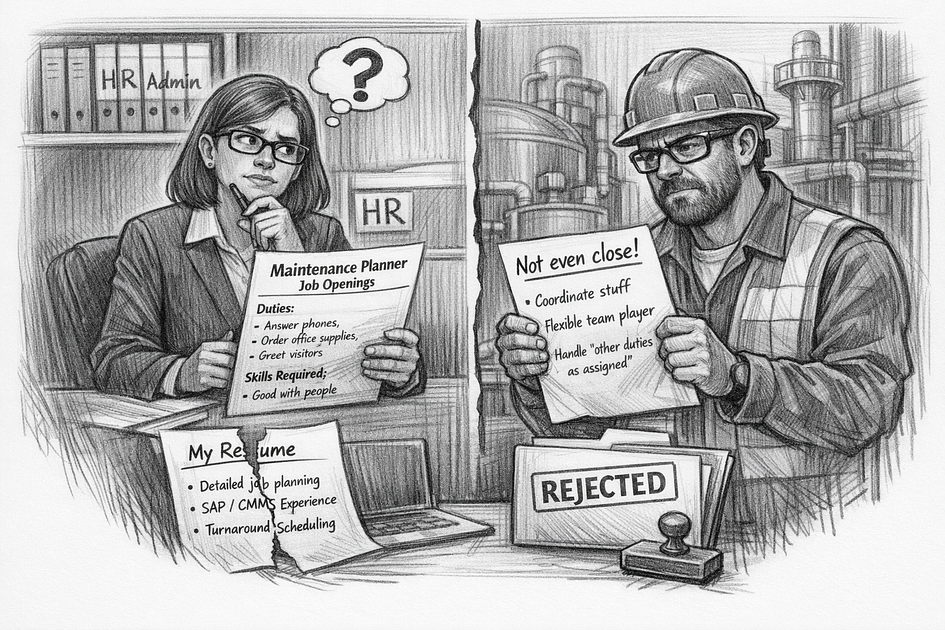
Why Job Postings for Planners Are Written by HR — and How That Works Against You
By John Crager | Next Shift
Published May 2026 | ~1,500 words | 6 min read
Somewhere in a corporate office building — far from any refinery, plant, or maintenance shop — an HR generalist is staring at a blank job description template. Their hiring manager sent them a three-sentence email that says something like: "We need a planner. Someone with P6 and SAP. Good communicator. You know what to look for."
They don't know what to look for.
So they do what any reasonable person would do: they pull up the last job posting for this role. Which was written by the HR person before them. Who pulled it from the one before that. Which was originally copied from a generic job board template in 2019.
And that's the document standing between you and an interview.
This is not an accusation against HR professionals. Most of them are doing their best with limited information in a role that spans everything from benefits administration to workplace investigations to talent acquisition. But when it comes to technical roles in industrial planning and scheduling, the structural gap between who writes the job posting and who understands the job is costing qualified candidates interviews every single day.
The Broken Chain of Job Description Creation
Here's how a maintenance planner job posting actually gets made at most industrial companies:
- A planning supervisor or reliability manager tells their manager they need to backfill a position
- That manager submits a headcount request to HR
- HR opens a previous posting for a similar role — or uses a generic template — and sends it to the hiring manager for "review"
- The hiring manager, who is managing a shutdown, coordinating a backlog review, and responding to seventeen emails, glances at it and says "looks fine"
- HR posts it
No one in that chain is a specialist in what a maintenance planner actually does. No one has benchmarked the skills against what the market currently requires. No one has thought carefully about whether "5–7 years of experience" means turnaround-specific or steady-state or both. No one has considered whether the salary range reflects 2026 market rates or 2021 budget guidelines.
The posting goes live. And it immediately starts working against you.
The Five Ways HR-Written Postings Hurt Planners Specifically
1. The experience requirements are either too vague or cartoonishly broad.
"5–10 years of maintenance planning experience in an industrial environment" tells you almost nothing — and tells the applicant almost nothing useful either. Does that mean 5 years of turnaround planning at a refinery? 10 years of steady-state planning at a water treatment facility? Both? Neither?
Meanwhile, the over-specified version — "Must have 10+ years of P6, SAP PM, Maximo, Microsoft Project, CMMS administration, RCM analysis, shutdown coordination, and capital project scheduling experience" — describes a career, not a job. No single person has deep expertise in all of those systems simultaneously. But because HR didn't know which three actually matter, they listed all of them.
If you don't hit 100% of a cartoonishly broad requirement list, you may self-select out of roles you're genuinely perfect for. Studies consistently show that women apply when they meet 100% of listed criteria and men apply at around 60% — but in the industrial sector, everyone tends to be conservative about applying when the bar looks impossibly high.
2. The keywords are wrong — which means ATS filters you out before a human sees your resume.
An HR generalist who doesn't know the profession doesn't know the language of the profession. They may write "project coordinator" when the industry calls it "turnaround coordinator." They may list "preventive maintenance scheduling" when what they want is "PM optimization and backlog management." They may say "work order management" when your resume says "work package development."
Your experience is identical. The vocabulary is different. The ATS — which is matching keywords in the posting to keywords in your resume — kills your application in 6 seconds before a human ever looks at it.
This is especially brutal in planning and scheduling because the role titles themselves aren't standardized across the industry. A Maintenance Planner at one company is a Work Management Specialist at another, a Reliability Coordinator at a third, and a Planning and Scheduling Lead at a fourth. HR pulls the title they've always used. Your resume uses the title you were actually given. ATS sees a mismatch. You're out.
3. The salary range is anchored to old data — or internal equity rather than market reality.
HR compensation benchmarks often lag the real market by 12–24 months. They're also frequently anchored to what the company paid the last person in the role — which may have been a decade ago, at a different experience level, in a different labor market.
In 2026, experienced turnaround planners with 15+ years of Gulf Coast refinery work should be commanding $110,000–$135,000+ in competitive markets. Some postings are still anchored to $85,000–$95,000 ranges that haven't moved since 2021. HR didn't set that range out of bad faith — they set it based on the tools and comp data available to them. But it means the posting attracts fewer qualified candidates, extends the search, and feeds the JOLTS gap we talked about in the last post.
4. The "required" vs. "preferred" distinction gets blurred — and candidates over-read it.
On well-written job postings, "required" means the minimum bar for consideration and "preferred" means nice-to-have. On HR-drafted postings for technical roles, these categories are often arbitrary — sometimes everything ends up in "required" because the template defaulted that way, or because no one thought carefully about what's actually essential vs. aspirational.
The result: a qualified planner with 18 years of experience sees that a bachelor's degree in engineering is listed as "required" — even though the hiring manager would happily take a degreed technologist or a non-degreed professional with the right field experience — and doesn't apply. The hiring manager never gets to see that candidate. HR never knew they existed.
5. Soft skills and cultural requirements are either missing entirely or written in corporate boilerplate.
"Strong communication skills" and "ability to work in a fast-paced environment" appear in approximately 100% of industrial job postings. They mean nothing. What actually matters — and what experienced hiring managers care deeply about in a planner — is almost never captured:
- Can this person push back on a work order that isn't ready for execution without creating a conflict?
- Can they communicate with a craft supervisor, a project engineer, and a plant manager in the same afternoon and be credible with all three?
- Do they understand that a schedule is a communication tool, not just a Gantt chart?
These things don't make it into HR-drafted postings. So candidates who actually have these skills can't signal them, and hiring managers keep wondering why the planners they're interviewing feel technically capable but somehow "not quite right."
What You Can Do About It
Understanding that HR wrote the posting changes your strategy entirely.
Treat the posting as a starting point, not a final specification. Use the keywords it contains — mirror them in your resume and cover letter — but don't limit yourself to its vocabulary. Add the industry-standard language that an HR generalist might not know but a hiring manager will immediately recognize.
Apply even when you don't hit every listed requirement. If you meet the core technical requirements — the ones that are clearly operational essentials — apply. The cartoonishly broad requirement lists are aspirational wish lists, not firm gates.
Get a human in the loop as early as possible. The HR posting is the worst version of the opportunity. The hiring manager's version — what they actually need, what they're willing to flex on, what they really care about — is far more favorable to an experienced planner. Find the maintenance superintendent, the reliability manager, or the turnaround manager on LinkedIn. Send a brief, professional note. You're not going around HR; you're supplementing a process that has a known structural weakness.
Decode the posting by reading between the lines. An overly long requirement list with conflicting experience levels ("entry-level preferred, 10+ years required") signals a company that doesn't have clarity on the role. A posting that's been live 60+ days signals the same. A posting with no salary range in a state that requires disclosure is a red flag. These are all signals about organizational maturity — and whether this is a role you'll spend six months in before realizing the company doesn't know what it wants from a planner.
The Bigger Picture
The HR posting problem isn't going away. As long as technical hiring runs through generalist talent acquisition pipelines, the job description will lag the actual job. For planners and schedulers — whose roles are evolving faster in 2026 than at any point in the last decade due to AI, digital twins, and changing operational models — that lag is getting wider, not narrower.
The candidates who win in this environment are the ones who understand the game. They reverse-engineer the posting, build the human connection, and walk into the interview ready to speak the language the hiring manager actually uses — not the language the posting was written in.
Your resume isn't the problem. The system is.
Now go work the system smarter.
John Crager is a heavy industry operations and planning professional with decades of experience in refinery and petrochemical environments. He writes about career navigation, credentials, and the future of the industrial workforce.
Follow the data. Trust the signal. Skip the noise.